

For us at Skeiron, cultural heritage preservation projects are always more than just work. They are a mission — our contribution to safeguarding what defines us as a nation.
The Roman Shukhevych Museum is of immense importance to Ukraine: it honors the memory of a key figure of the 20th-century liberation struggle and the Commander-in-Chief of the UPA, located at the site of his last battle and death. Its deliberate destruction by Russia on 1 January 2024 only emphasized its symbolic weight, turning it into a testimony to the contemporary struggle against attempts to erase Ukrainian memory and identity — and the effort to restore it has become a symbol of the indomitable Ukrainian spirit.
It all began back in 2021. Together with the Lviv Historical Museum and with support from the Ukrainian Cultural Foundation, we implemented the “Museum in 3D” project. Within that initiative we digitized, among other treasures of Lviv’s museums, several exhibits from the Shukhevych Museum. These were valuable items — witnesses to history. We also produced a number of panoramic images of the museum spaces. At the time we aimed to make the exhibition more accessible, to show it to the world, and to preserve it at least in digital form. We could not have imagined how prophetic that work would prove to be.
3D model of the bust of Roman Shukhevych. Scanned in 2021.
And then the morning of 1 January 2024 came. The news that a Russian drone had completely destroyed the museum came as a true shock to us. It was not merely the demolition of a building — it was a targeted attack on a symbol, on the memory of a man who fought for a free Ukraine until his last breath. Our goal became clear: not to let that memory disappear.
Almost immediately, together with colleagues from the digital heritage community, we went to the site of the tragedy. We had to act fast. Using photogrammetry, we created a detailed 3D model of the ruins — what remained of the house that had served as the last headquarters of the Commander-in-Chief of the UPA. It was necessary work: to record Russia’s crime and to document the loss.
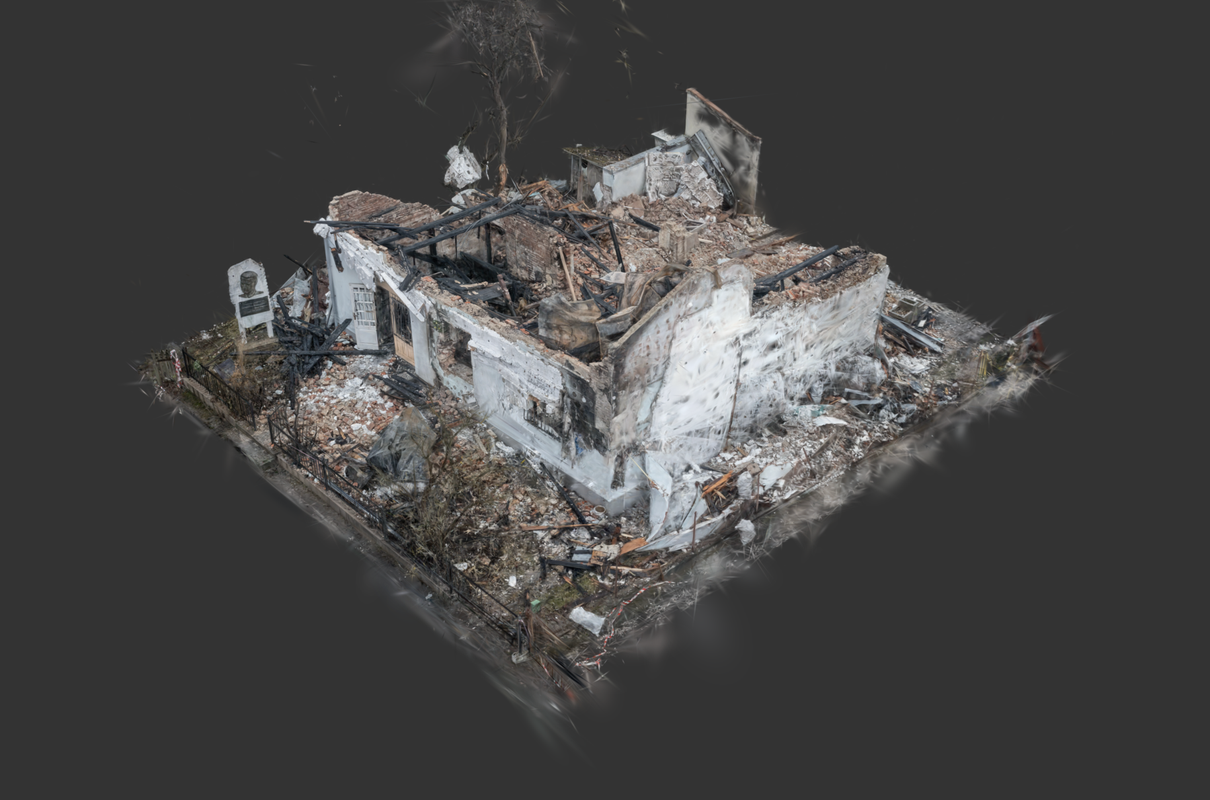
3D model of the Shukhevych Museum after its destruction on 1 January 2024.
But simply recording the destruction was not enough. We came up with the idea to recreate the museum virtually — to give everyone the chance to see it as it was before the attack. Our 2021 work proved invaluable for that. We took those first scanned exhibits and panoramas. The Lviv Historical Museum supplied additional materials, including more panoramic photographs. We scanned a few more important items to make the picture as complete as possible.
Late 2024 through early 2025 became a period of painstaking work. We combined all the elements — old and new 3D exhibit models, panoramic images and archival data. That is how a full-fledged virtual 3D tour of the Roman Shukhevych Museum was born. Now anyone, anywhere in the world, can “walk” through the museum’s rooms, examine exhibits in detail, read their stories and listen to the audio tour brilliantly narrated by Yaroslav Nudyk of Pikkardiyska Tertsiya. We even added an option to switch and view the 3D model of the ruins — a reminder of what happened and of the price of our struggle.
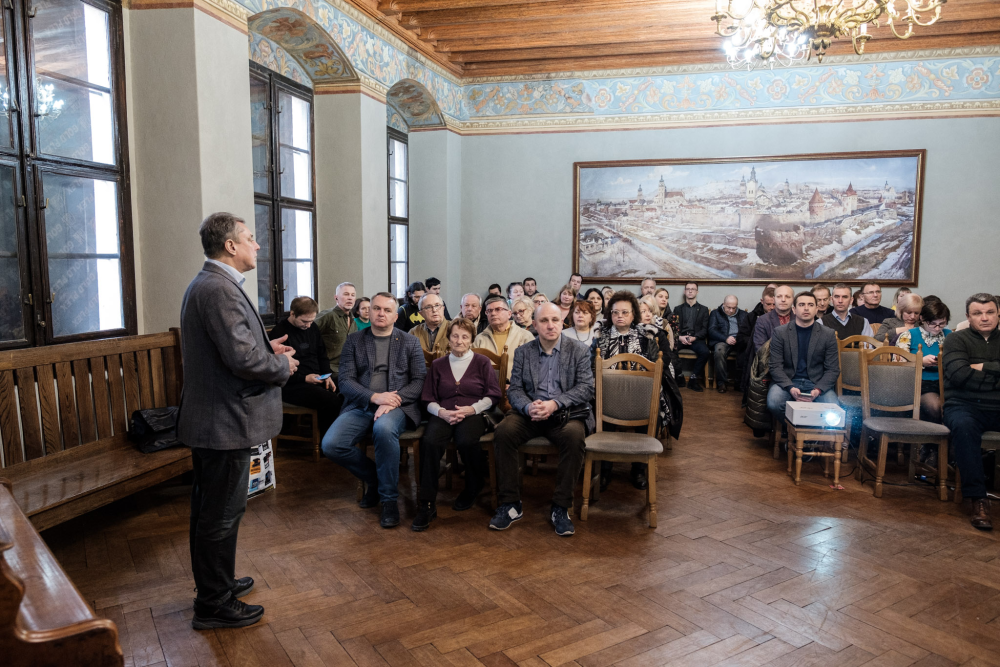
Virtual tour presentation. Photo: Lviv Historical Museum.
As technical specialists, we understand the value of such digital twins. These high-precision 3D models — both the one showing the museum before the destruction and the one documenting the ruins — are an invaluable resource. They will serve:
1. For memory and education. They allow people to learn about Roman Shukhevych and his last hideout, even if visiting the museum in person is impossible. They are a powerful tool against Russian propaganda that seeks to distort our history.
2. For researchers. They provide detailed material for the study of history, architecture and everyday life of the period.
3. For future reconstruction. The accurate “before” model will form the basis for planning restoration work and will help recreate what was lost as authentically as possible.
4. For documenting war crimes. The model of the ruins is incontrovertible evidence of the deliberate destruction of Ukraine’s cultural heritage.
This project is our answer to an attempt to erase history. It proves that memory cannot be destroyed by rockets or drones. It lives in memories, in archives, and now — in the digital space, available to anyone who wants to know the truth. As long as we remember, we are invincible.